Meet the World’s Best Restaurants 2026 by La Liste - At Da Vittorio, the Cerea family has turned hospitality into a living philosophy, where cuisine, service, and generosity flow from a shared family soul nurtured since 1966.

When evening settles over the hills of Brusaporto, the Cantalupa estate begins to glow as if illuminated from within. Gardens soften in the dimming light, pathways glimmer, and the air carries that unmistakable mixture of herbs, stock, and warm bread that signals a house preparing to welcome strangers as if they were returning relatives.
This atmosphere — refined yet unguarded — is not the result of design alone. It is the legacy of a couple who believed that hospitality begins long before a plate reaches the table: Vittorio Cerea and his wife Bruna, who opened their first restaurant in 1966 in the lower city of Bergamo.

In the beginning, Da Vittorio was small, modest, and profoundly personal. Bergamo expected meat; Vittorio insisted on fish. He spent countless hours driving to find the freshest catch, returning to the restaurant with crates that locals eyed with curiosity. Bruna welcomed guests with natural warmth, running the house with serenity even during its busiest hours.
Their five children — Chicco, Bobo, Rossella, Barbara, and Francesco — grew up inside that dining room, absorbing the rhythms of service and the intimacy of a place where every regular had a name, a voice, and a favorite dish.
When Vittorio died prematurely, the restaurant could have faltered. Instead, the loss drew the family closer. Bruna, with her characteristic steadiness, lifted the house onto her shoulders. Her children learned that grief could coexist with discipline, and discipline with affection. Everything they are now — the estate, the expansions, the identity — radiates from that moment of unity.
Over time, each Cerea sibling discovered their calling, shaping the Da Vittorio world in different registers, like instruments in a familial orchestra.

Chicco, introspective and meticulous, approaches cuisine with calm precision. His cooking is measured, thoughtful, sensitive to balance.
Bobo, expressive and instinctive, embodies the more expansive, joyful side of the kitchen. He moves with momentum, translating abundance into flavor.
Together, they form the culinary identity of the house: one refining, one amplifying — harmonizing without merging.
If the kitchen defines flavor, Rossella defines feeling. She is the one who receives guests, orchestrates the dining room, directs the pacing of service, oversees the elegant accommodations, and ensures that the entire experience breathes with humanity.
Her gift is instinctual: she senses what guests need before they articulate it. Under her guidance, service becomes fluid, warm, and sincere. Many houses offer technique; Rossella offers welcome.
Barbara works where the restaurant’s soul becomes an institution: behind the scenes, where process, coordination, and continuity take shape. She oversees internal operations, ensures the smooth flow of logistical details, and is deeply involved in the family’s charitable and social projects.
Her influence extends beyond Brusaporto to Cavour 1880, the historic patisserie and café in Bergamo that the Cerea family revitalized. Under Barbara’s care, Cavour’s pastries, chocolates, and polished displays echo the elegance of Brusaporto — a quieter, urban counterpart to the family’s grand dining house.
If Rossella orchestrates emotion, Barbara guarantees coherence. The house could not function without her.
Francesco plays a central role in shaping the operational and developmental side of the Da Vittorio universe. He coordinates major events, oversees logistics, and helps guide new ventures in Italy and abroad.
But his work is not solitary. The expansion of Da Vittorio — to the mountains, to Asia, into hotels, catering, and collaborations — is the result of collective intelligence. Strategies are discussed around a family table, where each sibling contributes insight, pragmatism, and ambition.
Francesco is one of the principal forces translating that shared vision into reality.
When the family moved from their original city restaurant to the expansive estate in Brusaporto, they did not abandon their roots — they amplified them. The property is less a relocation than a flowering: space for gardens, for courtyards, for light-filled dining rooms, for a rhythm that feels both luxurious and familial.
Walk through the estate and you see it immediately:
children laughing in the gardens,
staff exchanging nods and gentle jokes,
the calm choreography of preparation,
and everywhere — everywhere — Bruna’s unmistakable sensibility.
Despite their growth and evolution, the family maintains a living link to Vittorio. His dishes still appear on the menu, not as nostalgic tokens, but as active foundations.
The most iconic is the paccheri, a dish that embodies the father’s spirit: simple at first glance, profound in execution, comforting yet precise. Guests who order it taste not only a sauce but a memory — the memory of a small Bergamo dining room where a man insisted on serving what he believed in.
The paccheri now stand as the house’s most enduring signature — a direct line back to Vittorio’s kitchen.
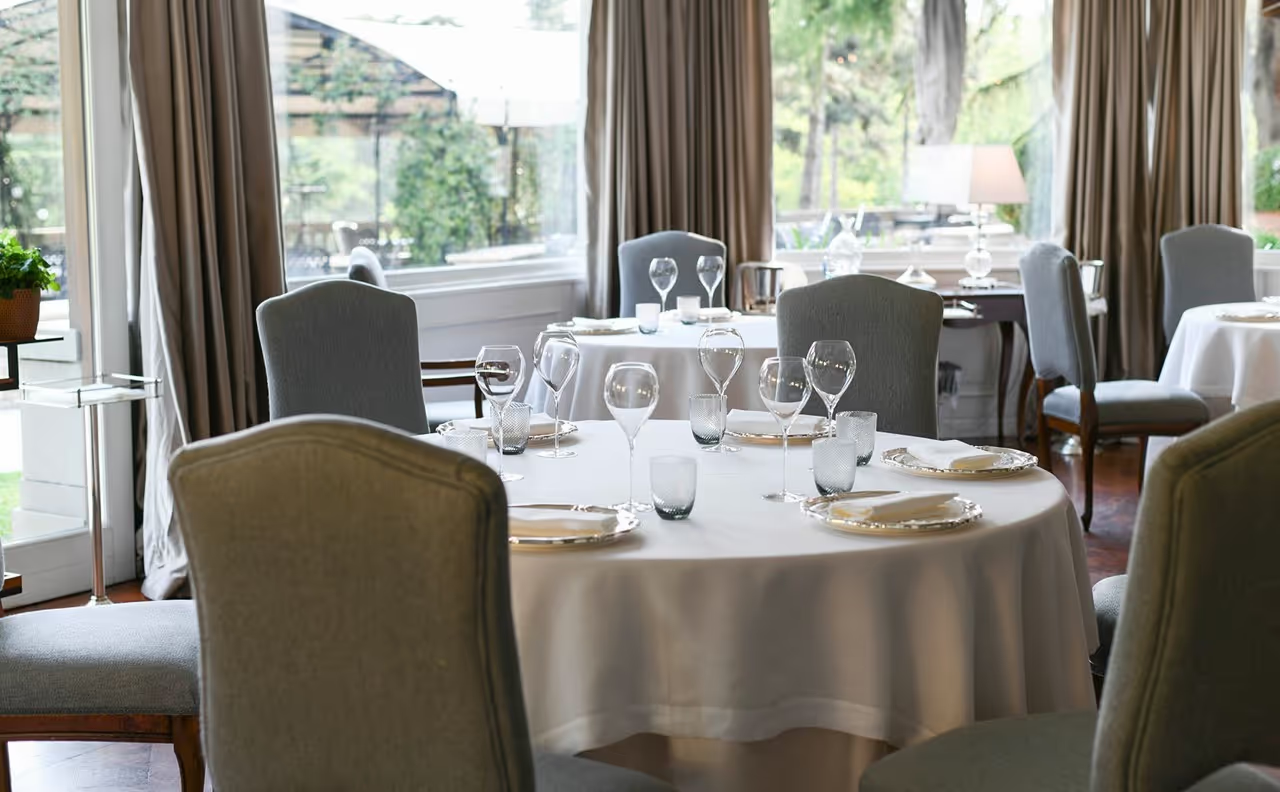
Today, the Cerea hospitality extends far beyond the gates of Brusaporto.
They have brought their cooking to mountain landscapes, where their Mediterranean cadence warms Alpine rigor.
In Shanghai, they established a house where Italian generosity meets a different cultural rhythm, translated with delicacy and respect.
Through events, catering, and collaborations, they have become ambassadors of an unmistakable culinary language.
What makes their expansion remarkable is not its scale but its fidelity. Whether in Asia, in the Alps, or in Bergamo’s historic center at Cavour 1880, the Cerea touch is instantly recognizable.

Visit Brusaporto at the right hour and you might witness the entire constellation in motion:
Chicco quietly refining a broth, fully absorbed in its balance; Bobo bringing delight and momentum into the kitchen, nudging a young cook with a conspiratorial grin; Rossella guiding the dining room with instinctive grace, sensing a guest’s needs before they become words; Barbara ensuring the house operates with quiet, unwavering precision, while Cavour 1880 carries her touch into the city; and Francesco, one of the principal minds behind the family’s growth, coordinating operations and helping shape new ventures — always as part of a shared strategic dialogue among all the siblings.
And then, amid the gentle hum of conversation, you may see Bruna, still present, still greeting guests with the serene warmth that has anchored the family from the beginning. Her presence makes every arrival feel like a homecoming, and every gesture in the house carries her imprint.
Nearby, young cooks prepare the father’s paccheri with deliberate care, as if Vittorio himself were watching from a familiar doorway. In that simple, precise movement — stirring, tasting, correcting — the entire philosophy of the family is alive.
What began in 1966 as a small dining room has become, through discipline, affection, and unity, a family enterprise sustained by generosity.
Not a myth, not a monument — simply a way of living, carried forward by five siblings who inherited not only recipes but a philosophy.
And wherever their work takes them — in Brusaporto, in the Alps, in Shanghai, or in the heart of Bergamo — one truth remains constant:
The Cerea family continues to transform generosity into a way of life.
Subscribe to our newsletter for the latest news, exclusive insights.

Find us or Socials or Contact us and we’ll get back to you as soon as possible.




.avif)